
Sam explains why Jesus was never married.
Tag: Jesus
-

Sam Kinison Last Stand
By Jane Wollman Rusoff
With additional reporting by A.J.S. Rayl and Jon Weiderhorn
Originally printed in Entertainment Weekly, No. 122
Friday, June 12, 1992“That’s when you know you’re pretty f—ed up, when it makes sense to fall asleep… I was driving between Needles and Barstow… It’s about 120 miles of desert… It’s four in the morning, man… Hey, this is a pretty good time to go to sleep … (SCREAMS HYSTERICALLY) So I totaled this f—in’ car out, man!… I f—in’ totaled it! And it made SENSE at the time!…” — FROM THE “SAM KINISON FAMILY ENTERTAINMENT HOUR,” APRIL 4, 1991
IRONY OF IRONIES: On April 10, 1992, almost a year after delivering that routine on HBO, Sam Kinison was killed in a head-on collision on that same stretch of arid desert road between Needles and Barstow, Calif., the same haunted section of U.S. Highway 95 that opens Hunter S. Thompson’s Fear and Loathing in Las Vegas. A 5’8″, 275-pounder whose appetites matched his bulk, a kamikaze comic known for his piercing screams and full-bellow takes on sex, religion, and drugs, Kinison was heading for a stand-up gig in Laughlin, Nev., five days after marrying his third wife, Malika Souiri, 27. Eleven miles north of Needles, a pickup driven by an allegedly beer-drinking 17-year-old smashed into Kinison’s Pontiac, leaving Souiri unconscious and the 38-year old comedian dead.
The greatest irony of all: Everyone thought he’d die sooner. With his massive addiction to alcohol and drugs, Kinison had been pegged by his friends and even by himself for a John Belushi-style demise. He once joked with friends that he’s probably be found dead one day “with a couple of 16-year-old girls in a cheap motel with an ounce of blow and a scissors sticking out of my back.” That he should die just when he seemed to be chasing the demons from his life – not exactly clean and sober, according to the autopsy report, but closer than he’d come in years – simply made no sense. And still doesn’t. In the weeks since he died, Kinison’s friends and family have tried to come to some understanding of his death and life, especially of those last bound-for-hell years.
Analyzing Kinison, once a troubled, rebellious child and later a holy-rolling preacher, they see a study in light-and-dark contrasts. He was “a shy little huggy bear,” says guitarist Joe Walsh, and also a man who “loved turmoil – that’s what made him tick,” says comic Allan Stephan, who often toured with Kinison. He had reportedly led a Black Mass or two in his time, yet “Jesus was always near his heart,” according to former girlfriend (and Jim Bakker nemesis) Jessica Hahn. He compulsively beat up men and women, yet was so respectfully devoted to his mother, Marie, that their relationship “was almost Elvis-like,” according to Sam’s brother, Bill.
All of us are creatures of complexity, but in Kinison the contradictions ran to wild extremes. “Most people would go to the edge,” says his friend Robin Williams. “Sam would jump over it.”
This is the trajectory of his fall.
THE EARLY PART of his story is well known. Born in Peoria, Ill., the third son of four boys in a family of poor preachers, he was bred into anger – whether from his upbringing in poverty, to the devil, no one was ever able to determine fully. He worked as a Pentecostal evangelist from ages 18 to 25 but eventually found his true calling in comedy. Starting at a club in Houston and gravitating to the Los Angeles laugh circuit in 1981, Kinison got his break in 1985, when Rodney Dangerfield put him on his young Comedians HBO special and gave Kinison what he would later call “the six minutes that changed my life.”
By 1987 Kinison had sold 100,000 copies of his album Louder Than Hell, hosted Saturday Night Live, appeared in Dangerfield’s movie Back to School, befriended the likes of Jon Bon Jovi, Ted Nugent, and Howard Stern, and was pulling in as much as $50,000 per concert gig. His comedy style was unlike anything ever heard – or, in his case, unlike anything ever heard outside of a psych ward: Addressing himself to starving Ethiopians, he roared: This is sand. Nothing grows here. Know what it’s gonna be like in a hundred years? It’s gonna be sand! you live in a f–ing desert! We have deserts in America – we just don’t live in them! Why don’t you move to where the food is?
But at the same time Kinison was telling friends that he was having major problems dealing with success. “He didn’t know who to trust,” says Walsh. “All of a sudden everybody wanted to be his friend. One time he called, depressed and crying. He said, ‘Am I blowing it?’ Sam never quite believed in himself, and it tore him up.”
It was around this period that Kinison’s rage, never completely repressed but now stoked by cocaine, began to explode. A pummeling of comic Mark Goldstein in front of Kinison’s stand-up alma mater, the Comedy Store, forced owner Mitzi Shore to give Kinison an ultimatum: “I told him I didn’t want him around until he cleaned himself up. He left and I didn’t see him again for two years.”
His girlfriend at the time, comedian Tamayo Otsuki (Davis Rules), found life with Kinison too rough to take. “As a person, Sam was a complete screwup,” says Otsuki. “He had a nice, soft side, like a 5-year old boy. But he was heavily into drugs. I left him about 60 times during the two years we saw each other. He’d call and leave 50 messages on my machine in one day. I finally had to disconnect my phone and move. I had to disappear because he’d come to my house and break in. He broke the window, the door, my chairs. His ego was hurt. He said, ‘How can you leave Elvis?’”
Malika Souiri, the Las Vegas dancer he started seeing after Otsuki and who he eventually married, describes her relationship with Kinison as “up and down like a roller coaster. I stood up to Sam lots of times, and I think he respected that.” Comedian Carl LaBove isn’t quite as delicate. “It was one of those drag-down, knock-down, fight-it-out relationships,” he says. “Sam took his punches too – she’s a kick-ass girl.”
Early in 1988, Kinison’s career began to lose momentum. In February, United Artists sued him for essentially walking out of what would have been his first starring film: Atuk, a piece of fluff about an Eskimo that goes to New York. Although the case was settled out of court, word went around that Kinison was unreliable and impossible to work with. The powerful Creative Artists Agency had already dropped him as a client. Then in May Kinison was dealt a ravaging personal blow. His brother Kevin, 28, the baby of the family, shot himself to death in his parents’ house in Tulsa after suffering a nervous breakdown. Kinison was devastated and began thinking about suicide himself. “Till the day he died,” says Bill Kinison, “Sam was still moved to tears when he talked about Kevin.”
The comic’s 1988 concert tour took in less than previous year’s, but that didn’t stop Kinison from playing the prodigal. He was paying off a house in Malibu and renting a four-bedroom apartment in Hollywood Hills. He spent lavishly on clothing, mostly from H. Lorenzo’s on Sunset Strip. He ate at Spago, Dan Tana’s, and the Palm and often left 100 percent of the bill as a tip. “He was very extravagant,” says comedian Richard Belzer. “Every meal was a celebration.” Although he dieted on and off, Kinison was a binger by nature. Descending on Ben Frank’s one night in 1988 with Hahn, his occasional date at the time, Kinison ordered sausages, bacon, eggs, buttermilk pancakes, and biscuits. “The grease made the Exxon oil spill look mild,” says Hahn. “And after eating all that, he said, ‘I feel good – want some dessert?’”
And there were drugs. Always drugs. Kinison’s booze and cocaine intake, never stinting, now began to rival his food consumption. In fact, a rider in his performance contract required promoters to provide an oxygen tank backstage. Its purpose: to revive him between shows. Comic Doug Bady remembers seeing Kinison “sucking on and oxygen mask before a show. I wondered how was he ever going to get out there. He looked like he was going to fall asleep or pass out. But he would undergo a transformation almost, and by the time he got on stage, he was right on.”
Avoiding unconsciousness was also a big challenge at home. “He hated to sleep,” says Hahn. “He’d practically have to pass out first.” One of Kinison’s domestic goals was to stay up till the early morning hours to watch reruns of his favorite childhood series, The Fugitive. Among his prized possessions was a pair of bar tabs signed by the show’s star, David Janssen.
By 1990, Kinison was an outlaw. The mere rumble of his name meant trouble. His album Leader of the Banned was selling poorly, and MTV dropped his video from its rotation. HBO backed out of a projected special. On tour, he was so high one night, according to guitarist Randy Hansen, “The audience began throwing things at him and chanting ‘Refund! Refund! Refund! He was barely able to stand up.”
Weirdness was everywhere. In June 1990, a 320-pound man, who had met Kinison hours before, allegedly attacked Souiri, who by this time was living with Sam, while the comic was passed out upstairs. She fired off four shots from one of Kinison’s many guns. The ensuing rape trial resulted in a hung jury and the case was dismissed, but the incident helped Souiri come to a definite conclusion about her life with Kinison.
“The party was over,” she says. “I felt it was good for us to stop everything and start to live life to its fullest.” The two made a pact to go straight, and Kinison joined an Alcoholics Anonymous chapter, where he befriended fellow member Ozzy Osbourne. In March 1990, Kinison began telling audiences he was no longer getting high.
The sad truth was that his new leaf stayed turned over for only a few months. After that, clean and sober was more of an image than a reality for Kinison. According to Randy Hansen, “Sam told me, ‘What’s important is that the audience believes I quit. Whether I’m doing drugs or not is none of their business. What I want them to know is that I don’t encourage anything…and that I try to be a role model.’ He wanted to get rid of that image of, ‘Yeah, let’s go get f–ed-up and party.’”
It’s said that even a fleeting exposure to the AA program can affect one’s life. So it was with Kinison. Though he was still drinking, his drug consumption went down, and he and Souiri slowly settled into a routine, non partying domestic life. The industry took notice. Kinison guest-starred on a Christmas episode of Fox’s Married…With Children in 1990, racking up the show’s highest ratings, and began negotiating for his own Fox series, Charlie Hoover.
But maintaining the new image wasn’t easy. In July 1991, Kinison missed an hour-long appearance on The Joan Rivers Show because he was too drunk to get our of New York City’s Plaza Hotel. Rivers admits she was furious but says, “Sam was devastated by it. He was upset because he thought he might lose his role in his series, which was to start in a few months. He really cared, for all the talk about his not giving a shit. He wanted the success. He was a pro and knew that a pro has to act in a certain manner.”
Charlie Hoover, a series of microscopic concept, featured Kinison as Tim Matheson’s 12-inch-high alter ego. Kinison didn’t put much stock in the show, but he showed up for work every day. And when it was canceled this February after a three-month run, Kinison had no regrets. He already has a few paths mapped out. On April 14, four days after he died, he was supposed to have signed with New Line Cinema, his first film contract since 1988; the two-movie deal called for a concert film and a comedy with either Arnold Schwarzenegger or Rick Moranis. That same day, Kinison was scheduled to sign with Fox for a variety show, a comedy hour patterned after the old Jackie Gleason Show, with Sandra Bernhard as his possible co star. This was going to be a good year.
Kinison was in a celebratory mood on April 5, when he married Souiri at the Candlelight Chapel in Las Vegas. They honeymooned for two days in Hawaii. “It was the most relaxed I’d ever sen him,” says Souiri. “This time, it seemed like it was really coming together.”
Two days later, Sam and Malika set off for his gig in Laughlin, with brother Bill and other friends following in a van. Bill saw the pickup truck heading directly toward Kinison’s car. With a steep embankment on his right, Sam had no room to maneuver. Both vehicles went straight up in the air on collision and crashed back down. Majid Khoury, Kinison’s personal assistant, who was in the van, found Sam “lying on his side diagonally across the seat, facing Malika, as if covering her at the time of impact. He was trying to get up and saying, ‘I don’t understand it. I don’t understand it. How come?’”
Then he lost consciousness and though CPR was attempted, Kinison lived only about three or four minutes after the accident. At the hospital, Souiri says, “I forced my way in to see Sam. I wanted to kiss him. But when I tried, blood came out of his mouth. I wanted something of him. I wanted anything on me – even his blood. It may sound sick, but I put some of his blood on my chest, over my heart.”
The death certificate states that Sam Kinison died of “multiple traumatic injuries.” The autopsy results, released May 27, showed signs of cocaine and prescription drugs in his system. The 17-year-old driver, who was allegedly drinking beer at the time of the accident, has been charged with vehicular manslaughter. A pretrial hearing was set for June 1.
In an interview last year, Kinison said that while his career was doing just fine, life was another story. “It seems to be one tragedy followed after another,” he said. “Just about the time you think life’s perfect, and you got it just the way you want it, something else comes up that breaks your heart, devastates you. And then you gotta get over that, and try to trust again, believe again, and set up for the next tragedy.”
Or, as he said on the highway between Needles and Barstow, “I don’t understand it.”
-
Friends Shocked by Violent Death of Mellower Kinison
By Amy Wallace
Times Staff Writer
Originally printed in The Los Angeles Times
Sunday, April 12, 1992The shock comedian was sobering up, associates say. A teen-ager is held in the collision
They were the kind of kids to whom comedian Sam Kinison’s bellowing stage persona was often said to appeal–two young men, in their late teens, driving fast in an old pick-up on a Friday night.
Their 1974 Chevrolet truck reportedly was filled with beer cans as they tore down U.S. Highway 95, swerving into oncoming traffic near the California-Nevada border. Moments after hitting Kinison’s Pontiac Trans-Am head-on, fatally injuring the comedian and knocking his new wife unconscious, one of the teen-agers had only this to say, according to witnesses: “God! Look at my truck!”
On Saturday, Kinison’s friends said they could not believe how he had died. The 38-year-old comedian, who made his reputation as a hard-drinking, loudmouthed wild man, had just returned from his Hawaii honeymoon with Malika, the 26-year-old Las Vegas dancer he had married a week ago today. He was settling down, friends said, sobering up and trying to “come into the mainstream.”
“I can’t accept it. Especially the fact that he was not doing anything wrong,” said comedian Richard Belzer, an old friend, who noted that Kinison was on his way to work–a sold-out show in Laughlin, Nev.–when he died. “He was going to a job. His wife was in the car. It wasn’t a drug overdose. It wasn’t self-indulgence. He was living a clean life.”
Immediately after the crash, which occurred near Needles at about 7:30 p.m., Kinison at first appeared fine, said friends who watched the crash from a second car and reported that beer cans from the pickup were strewn across the highway. With what appeared to be only cuts on his lips and forehead, he wrenched himself free from his mangled vehicle, lying down only after friends begged him to.
“He said: ‘I don’t want to die, I don’t want to die,’ ” said Carl LaBove, Kinison’s best friend and longtime opening act, who held the comedian’s bleeding head in his hands. Kinison paused, as if listening to a voice that LaBove could not hear.
“But why?” asked Kinison, a former Pentecostal preacher. It sounded, LaBove said, as if “he was having a conversation, talking to somebody else. He was talking upstairs. Then I heard him go, ‘OK, OK, OK.’ The last ‘OK’ was so soft and at peace. . . . Whatever voice was talking to him gave him the right answer and he just relaxed with it. He said it so sweet, like he was talking to someone he loved.”
Kinison died at the scene from internal injuries, according to authorities. An autopsy is planned.
Police did not release the name of the Las Vegas teen-ager who was driving the pickup truck, but California Highway Patrol dispatcher Tine Schmitt said the youth had been taken to Juvenile Hall in San Bernardino, where he was being held on suspicion of felony manslaughter.
Schmitt said the driver sustained moderate injuries and his passenger, also a juvenile, was more seriously hurt. Malika Kinison was in serious condition Saturday at Needles Desert Community Hospital.
Those in Kinison’s entourage speculated that the youths had been drinking. Majid Khoury, Kinison’s personal assistant, said there was beer in the back of the truck and in its cab. “It was all over the place,” Majid said. The CHP refused to discuss whether the two teen-agers were drunk or whether they had been given blood-alcohol tests.
Friends described Kinison as a warm man, generous to a fault–a description that seemed at odds with his brazen brand of humor. Especially in the early years of his career, the rotund comic was the king of shock comedy–vulgar, vitriolic and ear-splittingly loud. To many, he was downright offensive.
Where other comedians joked about sex, Kinison screamed about carnal relations among lepers and homosexual necrophilia. Other favorite targets included televangelists, women and Andrew Dice Clay, the abrasive comedian to whom Kinison hated being compared. He even had a few jokes about driving under the influence.
On Kinison’s 1988 album “Have You Seen Me Lately?” he defended drunk driving this way: “How else are we gonna get our cars home?”
But even Kinison’s critics admitted that he was much more than another gross-out comedian. At his best, he was a biting social commentator. The son of a preacher from Peoria, Ill., Kinison was particularly brilliant, many said, at dissecting religious hypocrisy.
In a riff on fallen televangelist Jim Bakker, Kinison imagined Judas, sitting in heaven, saying: “Maybe I’ll get a reprieve.” Jesus, meanwhile, “was goin’ through the Bible sayin’, ‘Where did I say: “Build a water slide?”‘”
Mitzi Shore, owner of the Comedy Store on Sunset Boulevard in Los Angeles, the club where Kinison’s act first caught fire, said: “Sam was a healer, a comedy innovator, a brilliance. To hear his tirades in the main room on his special night were moments in comedy that will never be repeated. Wherever Sam is now, he is resting and we will dearly never, never forget.”
Belzer called his friend “one of the best comedians of his age. Beneath the rebel was a man with a real heart who had something to say about religion and politics. A lot of the audience went (to his shows) to see the wild man. But they came away having done a double-take on certain issues.”
Rodney Dangerfield, another longtime buddy of Kinison, agreed.
“It’s a big loss to people who want to laugh,” said Dangerfield, who had featured Kinison in his 1986 movie “Back to School.”
In recent years, some said, Kinison’s act had gotten tamer. Instead of the homeless, he aimed his razor-wit at Vice President Dan Quayle, who he said was greeted at Cabinet meetings by the chorus: “Hey, Dan’s here. Anyone want anything from Burger King?” After the gay and lesbian community took him to task for his jokes about AIDS, Kinison publicly repented, calling himself “insensitive” and promising to no longer make light of the AIDS epidemic.
In his personal life, too, Kinison–who once described his past cocaine use as being so heavy he used a garden hose to inhale–had mellowed as well.
Kinison, who starred in the Fox comedy series called “Charlie Hoover,” had been negotiating with the television network to do a variety show and was expecting to sign a two-movie deal next week, said Bill Kinison, his brother and manager. He said the comedian was looking forward to getting off the road for awhile, leaving the reckless lifestyle behind and spending more time with his family and friends.
“We had taken a turn in the career that we had been wanting to take,” Bill Kinison said. “He knew he couldn’t live on the road forever.”
A week ago, before a small gathering of friends at the Candlelight Chapel in Las Vegas, he and Malika had formalized their five-year relationship–marrying at 2 a.m. on the birthday of Kinison’s late father.
“He said it would be a tribute, and an easy day to remember,” said Florence Troutman, Kinison’s publicist. Dressed in a tuxedo and red bow tie, Kinison wept, Troutman said, as he recited his vows. “He was very happy.”
Kinison and his wife spent last week at the Mauna Kea Beach Hotel on the Kona Coast, arriving back in Los Angeles early Friday. Kinison, who had been on a back-breaking road tour for much of the last year, had a sold-out show scheduled that night at the Riverside Resort Hotel and Casino. He was, friends said, revived and ready to work.
At midday, the Kinisons headed east, the lead car of a two-car caravan–Kinison’s brother, his personal assistant Khoury and LaBove followed in the van that also carried Kinison’s dog, a Lhasa apso named Russo. Three miles north of Needles, LaBove was startled awake in the back seat.
“I heard Bill saying: ‘Watch out for that guy, Sam. That guy’s in your lane,’ ” LaBove said. “Then I heard Bill scream, ‘Watch him, Sam! Watch him!’ Then I heard the most horrendous crash.”
The van skidded to a stop, LaBove said. Bill Kinison ran to check on his brother and, thinking that he was merely shaken, turned his attention to the driver of the pickup truck. The teen-ager was out of the cab, surveying his crushed windshield and seemingly uninterested in the human damage that had been done, LaBove said.
“He said: ‘God! Look at my truck!’ And Bill said: ‘You think you’ve got problems now, you don’t know who you hit,’ ” LaBove said. “He was thinking Sam was going to get out of the car yelling. He thought Sam was OK.”
-
Hate-Mongers Are a Sad Chapter in the History of Comedy
By Randy Lewis
Originally printed in The Los Angeles Times
Sunday, April 22, 1990The most important comedians have always been those who helped knock down the social, racial, economic and/or cultural barriers that keep people apart.
In the ’30s, Charlie Chaplin and the Marx Brothers made sure that society’s little tramps didn’t get steamrolled in America’s desperate quest for the better life. Though they worked from greatly different vantage points, Lenny Bruce and Bill Cosby contributed during the 1960s to the condemnation of culturally ingrained racism. And Woody Allen has built a career on giving hope to nerds throughout the world.
Along the way, comedians often have assumed the role that the sage assigned to journalists–“to comfort the afflicted and to afflict the comfortable.”
Unfortunately, some new-generation descendants of the greats have begun to worship the tools some of their forefathers used–stinging insults, graphic language, sexually explicit situations–without understanding the job for which those tools were employed. I refer to two of the today’s hottest stand-up comics, performers who have reached rock ‘n’ roll-star status capable of filling huge concert halls and arenas: Sam Kinison and Andrew (Dice) Clay.
Each is scheduled to play Orange County this week: Kinison in a club date at the Laff Stop in Newport Beach and Clay at the 18,765-capacity Pacific Amphitheatre in Costa Mesa. (Sam usually does larger facilities, but he booked this one himself, reportedly to help pay his considerable alimony bills.)
Both have captured the attention (I would have said “imagination,” but that’s far too complimentary) of the MTV-generation audience. Both appeal primarily to teen-aged males–no surprise, considering the heavily misogynist content of both their acts. If I were a woman and a date took me to see either of these wild boors, I’d ask for his money back–then hail a cab.
Though I’m at a loss to explain the popularity of either, Clay is the bigger mystery. (By the way, if you’re looking for lots of examples of their “jokes” here, forget it. The amount of each man’s material that can be quoted in a family newspaper probably weighs less than a stegosaurus’s brain.)
With Kinison, it’s easier to identify (if not identify with) the primal catharsis in some of his routines. On his first album, there was an underlying sense of true frustration at the hypocrisy he experienced in the life he led as a preacher before turning his back on the church and becoming the antichrist of stand-up.
Also, Kinison, unlike Clay, knows how to structure a joke that is created out of a unique (albeit generally base) perspective. And Kinison knows how to deliver a punch line.
One old routine about how difficult Jesus might have found it to explain his Crucifixion and Resurrection to a wife displayed originality, intellect and absurd juxtaposition of the real and the far-fetched. Sound comic principals, all.
But since then, Kinison has been caught up in his own fame: He spends nearly as much time on his latest album responding to Rolling Stone comments about his reputed wild lifestyle as he does creating “new” material. And that consists of inflaming racist attitudes toward Iranians, gays, women, the physically disabled and just about anyone in the world who’s not Sam Kinison.
Dice Clay, however, doesn’t even have that much going for him. How he has so quickly become a national phenomenon is a mystery that ranks up there with how TV execs ever thought Pat Sajak would one day unseat Johnny Carson.
If there’s more than meets the eye to Clay’s act–a leather-jacketed New Yawk street thug who brags about every bizarre twist on intercourse he knows–I can’t find it. Clay substitutes unbridled repugnance for viewpoint, odious epithets for insight. He’s as funny as a gang rape, as clever as a midnight mugging.
Lenny Bruce showed that comedy can be tough, brutal and sometimes even ugly in skewering the objects of his scorn. But those targets were small-mindedness, bigotry and hate–traits that Clay and Kinison would rather lionize. Their loathsome attacks on women, homosexuals, ethnic minorities and others aren’t pointed or thought-provoking. They are simply imbecilic. Perhaps Clay doesn’t make jokes about the chronically stupid because they would hit too close to home.
If there’s any rationalization for Clay’s moronic-punk persona, it could only be that he really is a brilliant performance artist whose very presence exposes how easily America can fall in line behind a crude, unthinking, spectacularly unfunny delinquent.
Could it be that both are so hugely popular for the simple reason that they accurately reflect, and give voice to, the values of their audience? That a young generation bred on the senseless brutality of slasher movies like “Friday the 13th” and “Nightmare on Elm Street” have become (to borrow Hunter S. Thompson’s pet phrase) a nation of swine?
Is it possible that, because celebrity worship has been elevated to the rank of religious experience, we have surrendered the ability to think critically when in the presence of a “star”? Otherwise, why would audiences grant not just their approval but their delight at attitudes and behavior that, if expressed by a child or a stranger at the supermarket, they would greet with the back of a hand?
More disturbing yet is the realization is that Kinison and Clay, because they are at the top of the stand-up comedy heap right now if only in terms of their ticket-selling potential, undoubtedly are spawning dozens, maybe hundreds of imitators who are dying to step into their dung-encrusted jackboots.
Remember the scene in Woody Allen’s “Manhattan,” when a question–how does one respond to neo-Nazis–pops up at a posh party of left-wing intellectuals? “We should go down there,” Woody suggests, “get some bricks and some baseball bats and really explain things to them.” When one haughty woman opines: “Really biting satire is always better than physical force,” Woody retorts: “No, physical force is always better with Nazis.”
But the best course of action simply may be the one you’d take with bratty children who misbehave just for the attention they can draw: ignore them and hope–no, pray–they’ll go away.
-
Press Release: Have You Seen Me Lately?
October 1988
A comedy explosion has swept across America in the ’80s, and in 1985, its most potent weapon was introduced to the public, Sam Kinison. From the minute he blasts onto the stage, Kinison, an ex-preacher, takes his audiences over the edge with his powerful approach which pushes comedy to its darkest, and often loudest, limits.
Kinison’s meteoric rise to the top has brought him fans of all types, ranging from the wild heavy-metal set to the John Does of America, and he has been applauded with an equal fervor from the critics. With a non-stop work schedule that includes films, concert, records and television specials, there is no doubt that Kinison’s controversial topics and behavior will continue ruffling feathers well into the ’90s. It’s in his blood.
His October ’88 album release on Warner Bros. Records, Have You Seen Me Lately?, is filled with Kinison’s trademark hard-hitting monologues. Kinison’s approach is outrageous, challenging, and hysterically funny, and it finds him jumping headlong into monologues about taboos, preacher scam artists, the Pope, sex, drugs, and rock and roll. With titles such as, “Robo-Pope,” “The Story of Jim (Bakker),” “Jesus The Miracle Caterer,” “Lesbians Are Our Friends,” “Pocket Toys,” “Parties With The Dead,” and “Sexual Diaries,” Kinison leaves no stone unturned.
The LP also finds Kinison embarking on his adventurous singing debut on the revised remake of the Troggs classic, “Wild Thing.” After bringing the crowd to it’s feet with an impromptu performance of the song at his sold-out show at the Universal Amphitheater in Los Angeles last July, Kinison decided to record the song and include it on his album. No surprisingly, Kinison has revamped the lyrics as only he can: “Wild thing, you made me trust you then stuck a knife in my heart. You lying, unfaithful, untrustable tramp…”
Kinison didn’t have to look very far for help in recording the song. Joining Kinison for this raunchy rendition were some of his biggest fans, including such notable rockers as members of Whitesnake, Poison, and Motley Crue. The recording, which was produced by Richie Zito, known for his studio work on Cheap Trick and Eddie Money, is accompanied by a video that turns the temperature up even more with its “who’s who” of rock ‘n rollers.
The video version, described by Kinison as “everything I always wanted to be in high school,” was directed by the acclaimed Marty Callner, and teams Kinison with his rocker pals, which includes none other than Jon Bon Jovi and Richie Sambora of Bon Jovi, Poison’s C.C. DeVille, Billy Idol, Rudy Sarzo of Whitesnake, Steven Tyler and Joe Perry of Aerosmith, Tommy Lee from Motley Crue, Slash and Steven Adler from Guns N Roses, various members of Ratt, and John Waite and Jonathan Cain. It also features the notorious Jessica Hahn as the ‘Wild Thing,’ and a special appearance by Rodney Dangerfield.
Logging over 250 concert appearances every year has helped Kinison achieve across-the-board success, and his popularity knows no geographical or cultural boundaries. Following his initial appearance on Rodney Dangerfield’s 1985 HBO Special, Rodney Dangerfield presents the Young Comedians, which Kinison filled with what he terms, “the six minutes that changed my life,” Sam’s career moved into high gear. He followed up with four appearances on Late Night With David Letterman and five guest shots on Saturday Night Live, culmination in a sixth appearance as the show’s host in November of 1986. Longtime friend and mentor Rodney Dangerfield asked Sam back for his 1986 HBO special, I Don’t Get No Respect and for a memorable part of Rodney’s crazed history professor in Back To School.
Kinison then starred in his very own HBO Special, Breaking The Rules, and his debut comedy album, Louder Than Hell, went on to sell over 200,000 copies, making it one of the biggest selling comedy albums of all time.
Currently looking to develop a feature film which would combine his two greatest loves, comedy and rock ‘n roll, Kinison is sure to continue his attack on the American psyche, while Have You Seen Me Lately? challenges his audience to follow him to even deeper depths. The question is, just how deep can he go?
-

Have You Seen Me Lately? (1988)
Sam Kinison’s second comedy album, released in 1988. Contains Sam’s hit version of the Trogg’s “Wild Thing.”
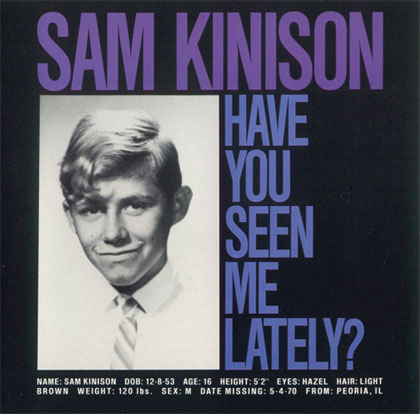
Sam Kinison – Have You Seen Me Lately? (1988) - “Rock Against Drugs?”
- “Rubber Love”
- “The Story of Jim (Bakker)”
- “Robo-Pope”
- “Mother Mary’s Mystery Date”
- “Jesus the Miracle Caterer”
- “Heart-Stoppers”
- “Buddies”
- “Lesbians Are Our Friends”
- “Pocket Toys”
- “Sexual Diaries”
- “The Butt and the Bible”
- “Parties with the Dead”
- “Wild Thing”
Resources